Proving Different Doesn’t Mean Less:
Welcoming Linda Bannon to Donka’s Board
By Anam Minhas
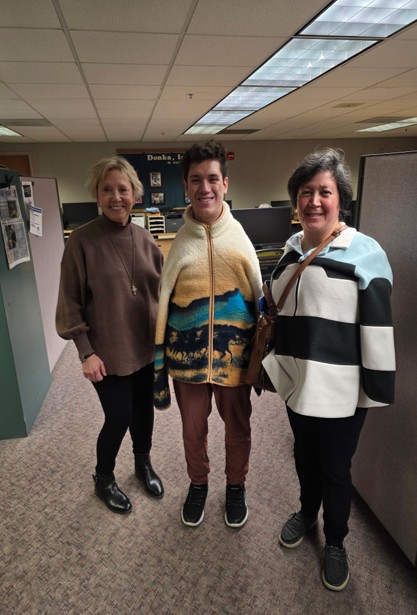
When Donka welcomed Linda Bannon, we gained more than a Board Member, we gained an advocate and educator whose life has been defined by resilience, innovation, and an unwavering belief in human potential.
Born with Holt-Oram syndrome and without arms, Linda grew up learning how to navigate the world differently, but from the very beginning, her parents encouraged her to approach life with determination and creativity rather than limitation.
“I want to see how far I can push the envelope, simply to say I did it. I want to prove I might be different, but I’m not less,” Linda said with determination.
As the oldest of five children, Linda was raised in Bellwood and later Hillside in a large,
supportive family that helped shape her independence and confidence. Her childhood was marked by inclusion at a time when accessibility and accommodations were far less
common than they are today.
“In the early ’80s, it was more of a sink-or-swim mentality, so I became a good problem
solver and found creative ways to make things work for me,” she said.
Recognizing Linda’s sharp intellect, her teachers refused to let her disability lower the bar for success. That belief in her abilities became a defining force in her life.
“My educational experiences, my teachers, and how they assessed each situation to adapt to my needs without lowering expectations truly shaped who I am today,” Linda shared.
Not every educational experience was positive though.
“I was raised in a Mr. Rogers world, where everyone was special,” she said, “so when one teacher was emotionally abusive and told me I wasn’t special, it was deeply discouraging and a painful contrast to the kindness and affirmation I grew up hearing.”
Those experiences, both positive and negative, ultimately inspired Linda to become the
kind of educator she wished every child could have.
“I wanted students to have someone to look up to, someone who supported them and
empowered them.”
After earning a full-ride scholarship to Triton College and later transferring to Elmhurst
University, Linda went on to spend 12 years as a kindergarten teacher.
While one school environment felt supportive and family-oriented, another became toxic enough that she made the difficult decision to step away for the sake of her mental health. Since then, Linda has found new purpose through freelance public speaking and advocacy work within the disability community. What began as a single classroom presentation at Elmhurst University — invited by a former professor and Donka Board Member, Jim Benzin— evolved into a recurring opportunity to educate future generations about disability, inclusion, and lived experience.
Outside of advocacy and volunteer work, Linda enjoys painting, crocheting, baking,
cooking, and music — passions rooted in family traditions and togetherness. She credits
her parents, grandmother, aunts, and uncles for teaching her the value of creativity and
community.
This “village” didn’t just prepare Linda for the world; it provided her with the foundation for her own journey into motherhood.
“My greatest accomplishment was raising a good human being and sending him out into
the world to do great things,” she said of her son, who was also born without arms.
Watching him navigate life independently and confidently has reinforced something she
deeply believes in: people with disabilities deserve the opportunity to discover their
own ways of succeeding.
“I realized early on that my son was just like me, Linda acknowledged. “Rather than letting me guide him through my lived experience, he wanted to figure things out on his own.”
That philosophy is why Linda felt drawn to Donka’s mission.
“I want people to understand that someone’s approach may be different, and it may take them longer to figure things out, but people can do anything if they’re empowered and supported,” she stated with conviction.
Linda values how Donka provides training and support services to people with disabilities to create a pathway to employment, recognizing that employment is the key to being an independent adult. As a board member, she hopes to connect more people with the resources they need and to remind them not to let doubt define what’s possible.
“Don’t take no for an answer,” she said. “If people are telling you, it’s not possible, find a
way to show them it is.”
Linda also hopes to utilize her position to encourage employers to rethink assumptions
about disability in the workplace.
“My mission is to make employers realize that people with disabilities are invaluable
problem solvers, born to be leaders,” Linda said, determined to change that perception.
Recent Comments